
Phase 1
Pain
Calm the pain down.
Hands-on care and soft tissue work ease pain and swelling, with therapeutic taping to support your knee as you move.
What We Treat
The squat you quietly stopped doing. The stairs you take one at a time. It’s fixable, and it starts with an evaluation that finds the cause, not a guess.
Sound Familiar?
Two or more? Keep reading.
Why It Happens
Your knees take a lot of load, and pain can come from several places. A torn or irritated meniscus. A sprained or torn ligament like the ACL, PCL, or MCL after a twist or a hyperextension. Irritation under the kneecap, often called chondromalacia or patellar pain. Arthritis. And often a hip or foot that isn’t doing its share, so the knee absorbs the extra strain.
Each of those calls for a different plan. Your evaluation sorts out which one is behind your pain. If you’re recovering from surgery, whether a knee replacement, an ACL, MCL, or meniscus repair, or an arthroscopy, we build your plan around that procedure.
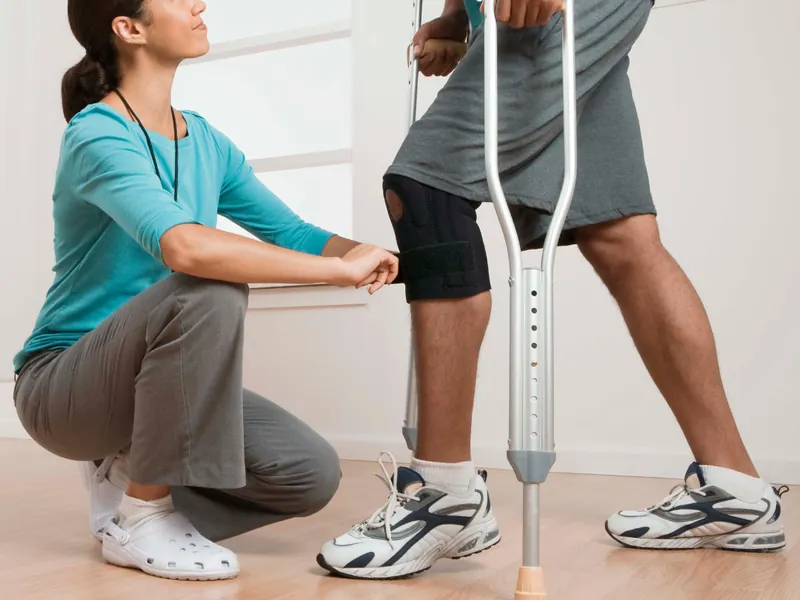
The Honest Truth
The sooner you start, the sooner you know exactly what you’re dealing with.
How We Fix It
Every plan has an endpoint. Here’s what the four phases look like for a knee.
Phase 1
Pain
Hands-on care and soft tissue work ease pain and swelling, with therapeutic taping to support your knee as you move.
Phase 2
Prime
Joint mobilization and guided exercise restore the bending and straightening you’ve lost.
Phase 3
Perform
Progressive strengthening for your quads, hamstrings, and hips builds a knee that holds up on stairs, slopes, and squats.
Phase 4
Prevent
Walking, running, or sport-specific movements get tested under real load before you’re done: that’s the endpoint, not just another appointment.
When I began therapy, my knee ached constantly and I required an ankle splint to walk a block. As a result of the excellent treatment here, I now walk more than half a mile with almost no pain or discomfort.
Shared by Gayle T. · Knee pain
Before: my knee ached constantly and I needed an ankle splint to walk a block
After: walking more than half a mile with almost no pain
Questions, Answered
Many meniscus and ligament injuries are treated with physical therapy, and when surgery is needed, therapy before and after it matters. Your evaluation looks at how your knee moves, how stable it is, and how much strength you’ve lost. If you need to see a surgeon, we’ll tell you.
Yes. We work with patients after knee replacements, ACL, MCL, and meniscus repairs, and arthroscopy. Your plan follows your surgeon’s guidelines while we rebuild your motion, strength, and confidence.
No. Louisiana allows direct access to physical therapy, so in many cases you can start without seeing a physician first. If you do have a referral, bring it with you. Questions before then? Call us at (318) 222-7442.
New patient evaluations typically last about 60 minutes, and follow-up sessions typically run 45 to 60 minutes. We verify your insurance benefits before your first visit, so you know what to expect.
Book Your Visit
Request a time and a real person calls you back during office hours. No phone tree. No ‘someone will reach out.’ Just a plan.
5.0 · 36 Google reviews
We call you back during office hours
Step 1 of 5
That’s the hard part done. We’ll call during office hours to lock in your time.
Visit Us